
CROMOBLOCK
by Ilaria Bignotti
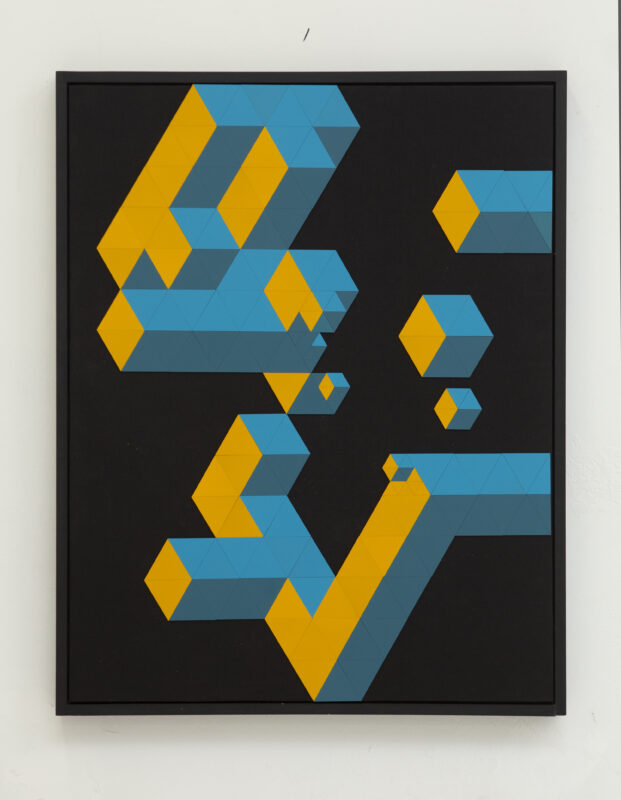
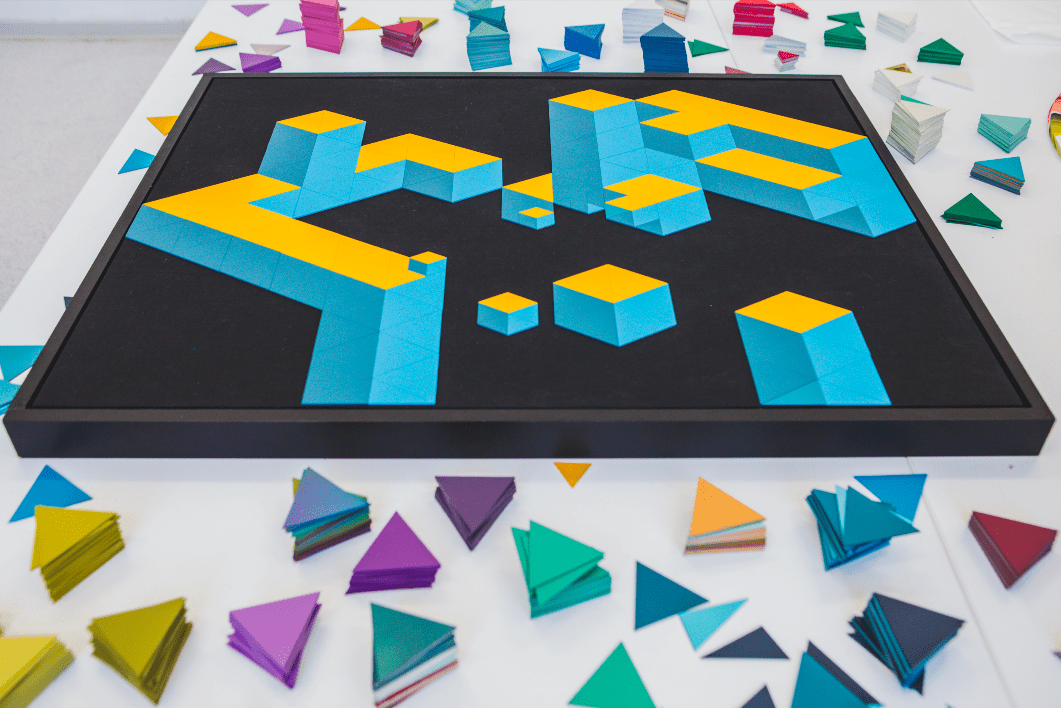
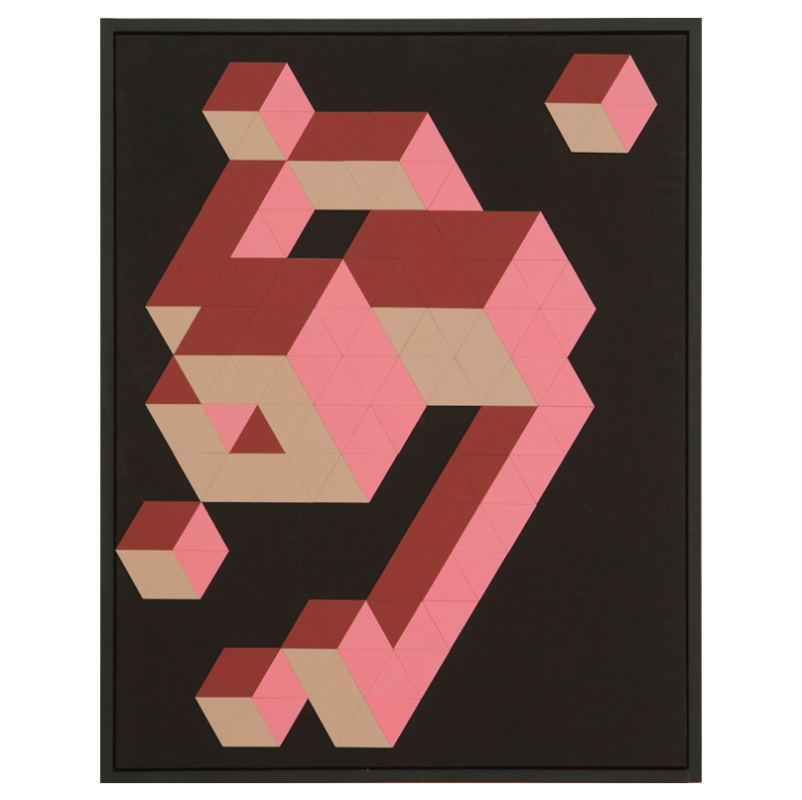
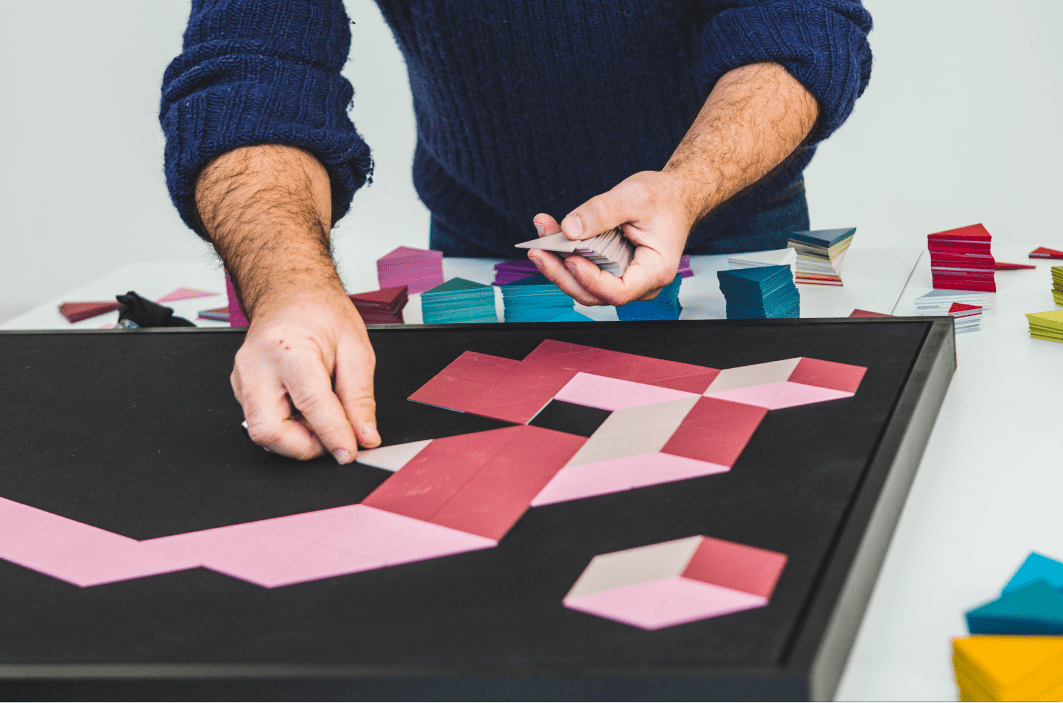
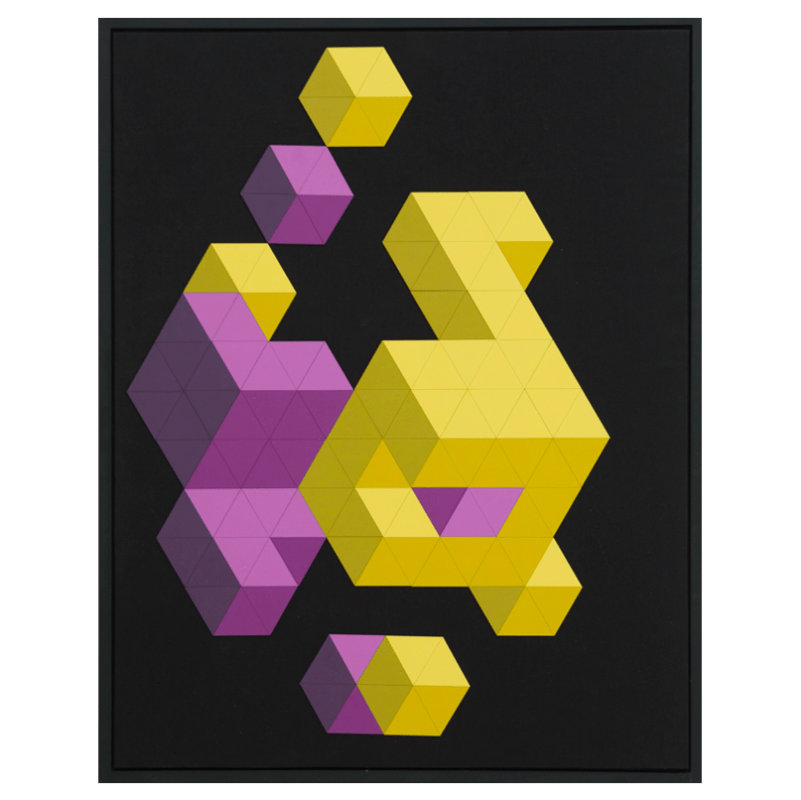
Cromoblock is a new project by the artist Riccardo Ten Colombo, curated by Ilaria Bignotti. Equilateral and right-angled iron triangles, painted with industrial colors, are arranged on magnetic boards, forming a composition of precisely-designed cubes and parallelepipeds, which emerge from the black background, thanks to their threedimensional illusion.
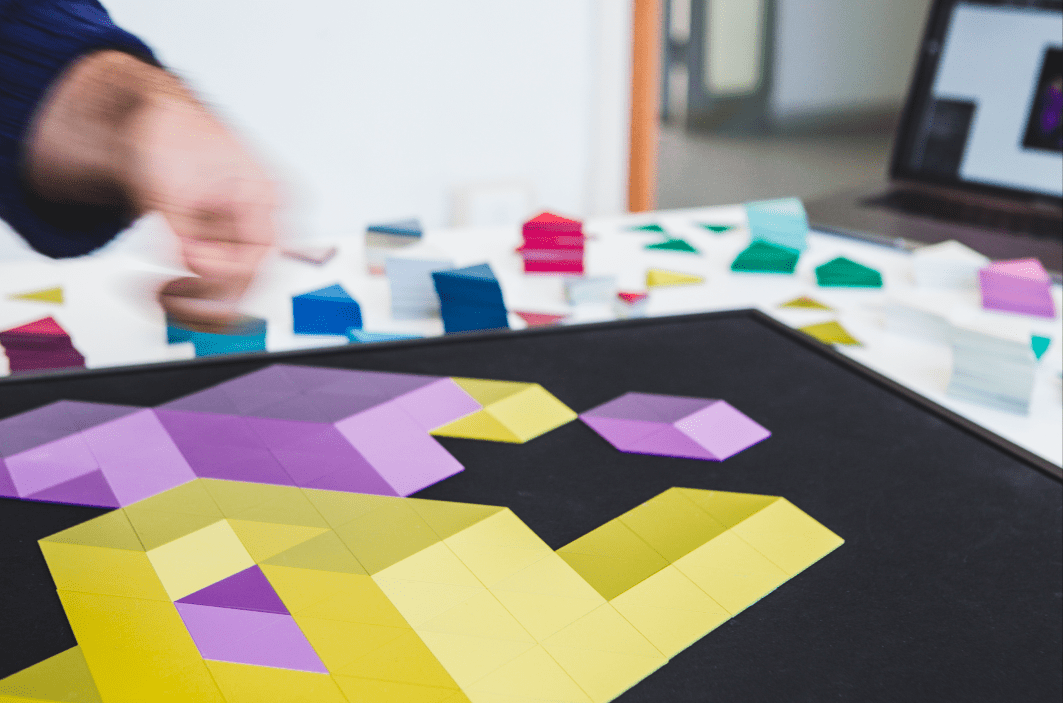
Magnetic tables and geometric shapes create dynamic three-dimensional configuration, potentially always in transformation: in fact, the viewer can manually modify the artworks. Color, perception, experience and interaction are the crucial elements of this new production, which, due to its language and research, fall within the historical line of the international kinetic and programmed avant-gardes. The combination of plastic power and dynamic energy of the artworks, as well as their flawless, crisp form, make these boards magnetic for the gaze too, by attracting it to the form-generating field. The visual seduction attracts the viewers and invites them to take an interactive action: the compositional elements can be broken down and remodeled on the table.
What will happen?
Not even the artist can know this: the work, brought into the world by his ideational and constructive ability, can be transformed every time, put back into the world by whoever owns it. Project and chance, freedom and rule, manual skill and technology - Riccardo Ten Colombo has been studying this project for 4 years and has created a small painting workshop in his studio in order to be able to follow the phases of realization, thus guaranteeing the work an undisputed artisanal value of high quality and proven authorship - are the dynamic elements and opposites that come together in this project. Which takes us back to a dimension, first of all, of playful possibility: in a certain sense, that black background is a screen between past and present, a germinal place from which, as from our memory, we can still recall the memories of when, lying on a carpet, we composed forms and imagined worlds.
A message of very high value, especially today, at a time when design hopes must be kept on constant alert, to imagine new ways of building and living the environment and the relationship with oneself and with others.
In this direction, as well as for the inevitable formal reference, Riccardo Ten Colombo stands as a young Italian artist who walks along a path traced by the historical currents of abstract-constructivist ascendancy: how can we not feel, in this careful use of colors that are so present in all of Colombo's research, and even more so in this project since the title, an echo of the songs of colors in the forms of Kandinsky, when at the beginning of the twentieth century he asked artists to listen to their own time and make it resonate in a research capable of rising spiritually?
Between Russia and Germany, his theories were among the teachings of that "house of construction", the Bauhaus, where they wanted to tell everyone that art is an instrument of social construction, a concrete way to imagine and create a new world, democratic, fertile with talent and peace. In the Netherlands, the visionary founders of Neoplasticism composed works, objects and environments with squares and triangles, primary colours and linear strokes of black; in Russia, chromatic reduction, plastic sensitivity and an immeasurable metaphysical tension were the basis of Malevich's extraordinary invention: squares, but also other shapes, stood out in white against a black background, black against a white background. And the colours were the bricks of a community project, that of Constructivism, as visionary as the spiral tower of the Third International.
In France, meanwhile, there were those who chose to fly over the roofs of Paris, and to decompose its marvellous architecture into exact and interpenetrating forms - Delaunay; then there were those who, from Hungary, arrived in Paris with a Yellow Manifesto, to tell how art could become perception, kineticism, a mutable grid of forms and combinations - Vasarely.
But this is already the origin of the second generation of artists who made the relationship between abstraction, geometry, colour, the science of vision and new technologies into a social, international and ethical project, even more than an aesthetic one: the programmed and kinetic neo-avant-garde movements of the 1960s are all present in the work of Riccardo Ten Colombo. In his Cromoblock we find the serious games of Munari and Mari, the pulsating and changing spaces of Colombo, the magnetic combinations of Varisco, but also, on the other side of the Alps, the crystalline fantasies of Max Bill, and the courageous visions of Ivan Picelj and Vjenceslav Richter, founders in Zagreb of that international movement called New Trends. Riccardo Ten Colombo is a child of his time, however: he carries a long history of art not on his shoulders, but in his heart; he wants his work to belong to everyone: for this reason he leaves it open to discovery and transformation. And, on the other hand, he also knows that a work of art is a value: this is why he creates unique pieces, which can indeed be broken down and transformed by those who own them, in infinite variations. But, through the authentication document that accompanies each work, it can return to being, if its owner wants to try, the original image conceived by the artist. Enriched by the creative gesture of each of us. A changing work, an eternal work.